Tuesday, May 12, 2009

Rooftop As A Green Space

“..rooftop has been a space that, on the rare occasion, has been celebrated, it has largely been forgotten or ignored within the built environment. At its most architectural, it serves to crown the top of the building. At its most functional, it serves to protect us from the elements. It is probably little surprise that rooftop accommodation has tended to be the least desirable.” --James Pomeroy, Room at the Top, Futurarc.


Living area, dining area, kitchen, bathroom, bedroom, balcony/terrace the spaces we immediately think of when we are ask to identify usable spaces in our house. But, how about the rooftop? Could we consider the top of a roof as living space?


Roof the top most covering of a building; provides protection against rain, snow, sunlight, extremes of temperature and wind. Rooftop is the roof of a house or building including all its necessary construction material. It is as important as every parts of a structure, may it be in a house or a multi-storey building. For span of time, “the roof” is boxed on one simple function: a crown used as covering for protection. In our locality, rooftop as a space was given less attention, for some it is a waste space and for most buildings, a space where mechanical plant can be housed. But rooftop offers more than just a simple storage space, a left over space.


The rooftop as a green space is growing increasingly all over the globe. In Europe, the use of space on rooftops have been widely known since the Middle Ages. Sod roofs were an attribute of some houses in North America. Germany ventured into roof landscaping in the aft of oil crisis during early 70's to conserve energy. While in developed and highly urbanized cities, the used of land was intensified and sooner, scarcity of available land for development will become a major issue. Flat roofs of residential buildings and roof garden in office blocks is one of the possible options for the future.


Adapting such green practices in our neighbourhood is very helpful, especially today that people is starting feel the effect of global warming, complaining to have greener environment and bringing greener landscape to urbanized downtown area will do more since it will not occupy large area of land. Rooftop developments (roof gardens specifically) will break through the monofunctionality of a neighbourhood. Roof gardens benefits include reduced energy demand, attractive urban views and wildlife habitat.


Time passed, designs evolved, scarcity of land become a major issue, rooftop developments might be a possible solution to urban development without disintegrating the environment. Leah Damalerio

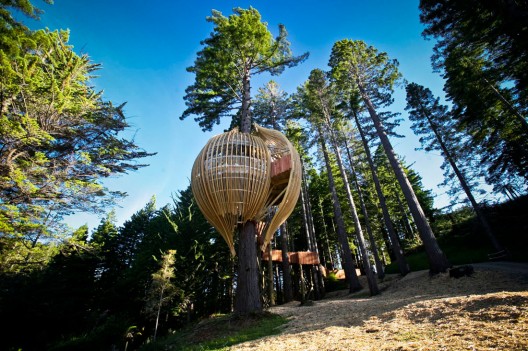
Cohabitation


A tree house in New Zealand is crafted as a restaurant. It was created for a ‘reality’ TV advert as an off the wall functioning restaurant. Hanging on a Redwood tree, which is over 40 meters high and 17 meters in diameter at the base, the structure is shaped like an onion. With an open plan, it is accessible through a 60 meter tree-top walkway trailing behind it.

It was conceived along humble functional requirements, considering its organic setting and unusual location. Requiring only 18 seats, a bar with a waiting staff, it fits the wrapping plan proficiently. However the kitchen, catering facilities, and toilet are located on the ground level. The vertical lines draped around it make perfect camera angles and unobstructed views into its natural surroundings, which it blends with effortlessly. It is a necessary quality considering the demands of filming the advertisement. Almost 10 meters wide and over 12 meters high with an overwhelming natural exterior the onion-shaped tree house can almost be an unmistakable fruit growing out of a tree trunk.

Looking past its foremost intention, a film-advert-architectural-piece, this architectural feature suggests a promising potential. Perhaps an organic-producing developed society which may only be existent in science fiction or it can also possibly be a lost civilization in Amazon. No wonder it displays such architectural promise and excellence it weave itself with nature effortlessly without dominating its immediate surrounding. Again, beyond its intention we could easily see and imagine this seemingly delicious-eye-warming-idea of an advanced society cohabiting with the trees, like a literal exchange of natural processes between living organisms, as if a clean polished architectural fantasy already existing in science fiction.

Extending this architectural fantasy there can be fruit farms just lying at your backyard that may become as common as the usual green patch that we are all familiar. The main road is then transformed into a bustling hanging bridge with sturdy supports on the rich green and very much alive grassland below our houses. Work can be forests away and you may have to take a few zip lines to get to it. Malls would be these intricate weave of spaces hanging under and over bridges. It is like setting technological proficiency to match that of nature’s will and ability, never toning it down but leading it to a way in which it ‘grows’ with the natural processes.

Then the presence of animals would already be inherent to us, in which we approach our lives and our daily solutions with their consideration or because of them. And perhaps limits would have to be necessary in order for them and us to survive. Vegetation would be everywhere. On ground level, on bridges, on our houses, that the over all picture it conveys would be a park, a market place, a farm, a house, a bridge and a corporate building (with natural ventilation evidently), mashed up into an organic sculpture that grew on its own. Finally it can be as optimistic as branches reaching out for sunlight or as predictable to that of opening windows for letting some air in on a hot day. El Vim Cabazares

Monday, May 11, 2009

CONSTRUCTION MANAGEMENT


Construction Management Davao

Services

• Preparation of Bidding Documents
• Bidding Evaluation and Management
• Project Time Scheduling
• Technical and Administrative Coordination
• Periodic Progress Report and Evaluation
• Punch Listing
• Testing and Commissioning

Thursday, May 7, 2009